
And what that shift means for fulfillment reliability, margins, and long-term scale
The rise of direct-to-consumer (DTC) meat brands has reshaped far more than marketing and customer acquisition. It has forced brands to own the entire cold chain.
In traditional wholesale, temperature risk is distributed across processors, distributors, carriers, and retailers. In DTC, that buffer disappears. From pack-out to porch delivery, the brand alone absorbs the risk.
One thawed box can trigger refunds, reships, negative reviews, lost trust, and permanently damaged lifetime value.
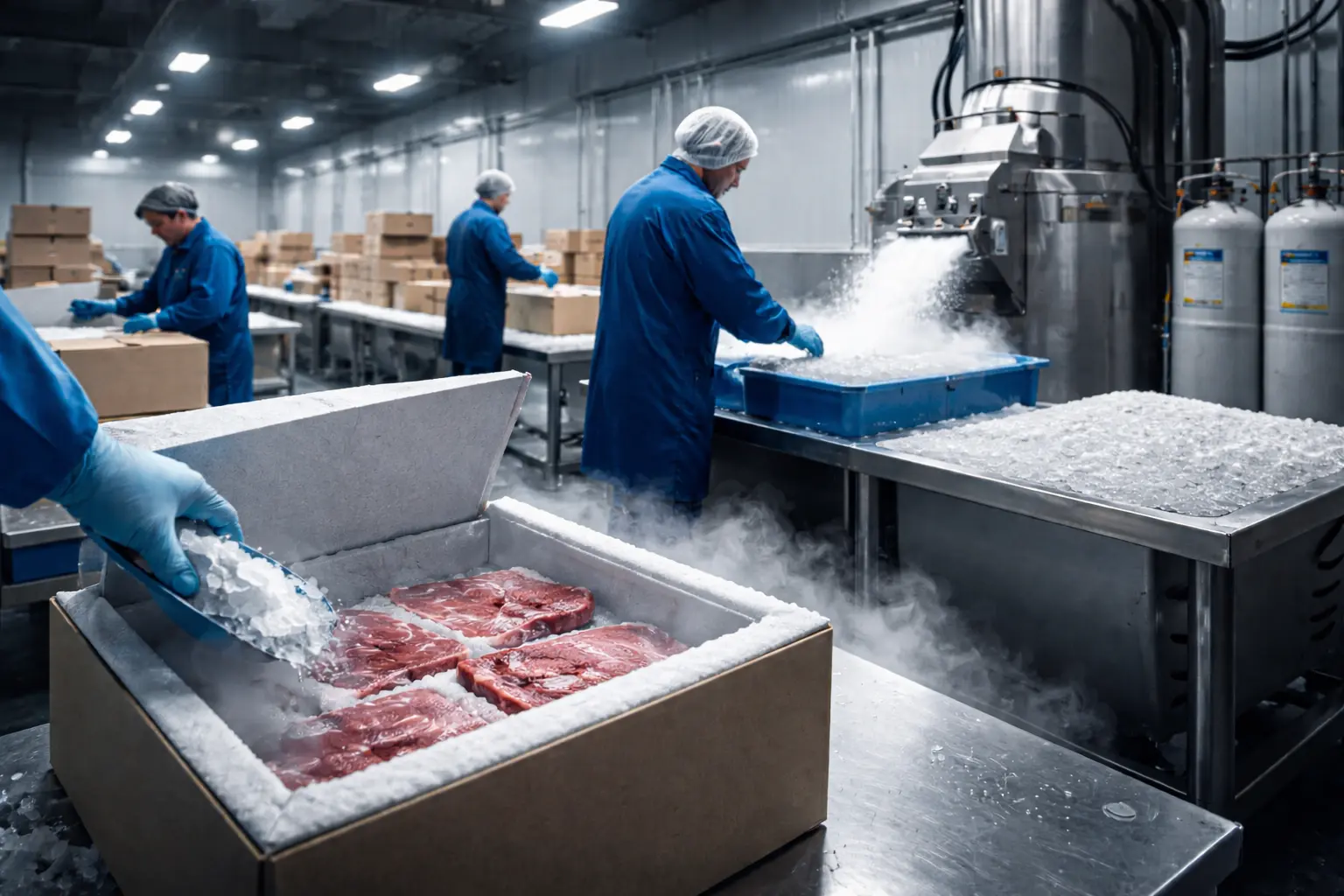
Dry ice—once a routine consumable—has become mission-critical infrastructure. Without it, shipments stop. When shipments stop, the business grinds to a halt.
Three structural factors make DTC meat uniquely vulnerable:
The asymmetry is brutal. One compromised shipment can erase the margin from 20–50 successful orders.
While most brands carefully model carrier rates and packaging costs, few adequately account for exception volume. In bad seasons, refund and reship rates of 5–15% can quietly devastate profitability.
Conversations with DTC operators reveal the same recurring problems:
These costs rarely appear as clean line items. Instead, they surface indirectly as:
In frozen DTC, short-term cost optimization often backfires. Reliability delivers far greater long-term returns.
So how much dry ice do you actually need—and where does risk start creeping in?
Most brands underestimate demand by looking at averages instead of worst-case transit, peak heat, and exception volume. To make this concrete, we built a practical calculator that estimates dry ice requirements based on shipment volume, transit time, and risk tolerance.
👉 Calculate your real dry ice demand here:
https://socaldryice.com/tools/dry-ice-demand-calculator/
Dry ice defies normal supply-chain logic:
If boxes or liners run short, brands can improvise. If dry ice disappears, fulfillment stops entirely.
Before the DTC boom, dry ice distribution was built for labs, industrial cleaning, and sporadic users—not for:
As DTC meat demand surged faster than supply infrastructure adapted, the mismatch became severe. Suppliers responded with higher prices and restricted access. Forward-thinking brands filled the gap themselves.
At moderate volumes, many brands hit an inflection point where external reliance becomes a liability.
| Aspect | External Supply | In-House Production |
|---|---|---|
| Schedule control | Supplier dictates pack windows | Full flexibility—pack when needed |
| Costs during spikes | Rush and premium fees (50–200% markups) | Fixed production costs |
| Supply reliability | Shortages common in summer/holidays | On-demand availability |
| Quality consistency | Variable pellet size/density | Output tailored to packing needs |
| Scaling dynamics | More volume = more dependency | Volume amortizes equipment faster |
| Operational drag | Constant coordination and fire drills | Integrated into pack flow |
| Long-term margin impact | Erosion via exceptions and churn | Often 20–40% effective savings |
At sustained volumes (often ~500+ boxes per week), dry ice becomes the single largest operational vulnerability.
This shift is not about novelty—it is about risk elimination.
ButcherBox offers a clear case. During pandemic-era shortages—exacerbated by CO₂ diversion—they faced repeated supply disruptions. In response, they opened a dry ice production facility in Oklahoma City in 2021, producing up to 111,000 pounds per day. A second facility followed in Iowa in 2022. Leadership framed the move simply: owning dry ice meant owning their destiny.
Riverbend Ranch took vertical integration even further. By launching on-site dry ice production alongside their Idaho processing plant (circa 2023), they ensured fresh ice for every DTC shipment, reduced thaw risk on long transit lanes, and controlled quality end-to-end.
Modern dry ice systems are compact and modular—not sprawling factories.
Production aligns with pack days. Batches are sized precisely to outbound volume, using liquid CO₂ delivered in bulk—often easier to schedule than dry ice trucking.
Most DTC meat brands rely on pelletizers because pellets distribute evenly, allow precise dosing (typically 5–15 lbs per box), and suit weekly cycles.
Common systems include:
Brands often start with a mid-range unit sized to current weekly volume, then add capacity as shipments grow.
For longer transit times or premium shipments, block systems are sometimes added to reduce sublimation. Many operators run hybrid setups: pellets for standard orders, blocks for higher-risk lanes.
In-house production shifts dependency from dry ice trucks to liquid CO₂ bulk delivery.
While CO₂ contracts and on-site storage tanks require planning, bulk delivery is generally more predictable and less volatile than finished dry ice logistics.
Producing dry ice on demand reduces waste from over-ordering and sublimation losses. It also cuts transport emissions tied to emergency deliveries.
Operationally, consistent dosing simplifies compliance—standardized labeling, handling procedures, and fewer rushed errors under FDA and USDA food-grade guidelines.
In-house production is not for every brand. Key considerations include:
For brands with predictable cadence, ROI often arrives within 12–24 months, driven less by unit cost savings and more by avoided exceptions.
If your shipments are predictable, subscription-driven, and standardized, many operators find the opposite: they waited too long.
DTC meat demand is structural. Nationwide frozen delivery remains core to the model. Owning dry ice infrastructure future-proofs operations against volatility.
This is not about saving a few cents per pound.
It is about trading dependency for sovereignty—predictable operations, protected margins, and scalable growth without single-point failures.
Every DTC meat brand eventually faces the fork:
Absorb supplier risk indefinitely—or invest in control.
This shift is not hype. It is pragmatic resilience for a maturing category.